
87th AERO SQUADRON (1917 – 1918)
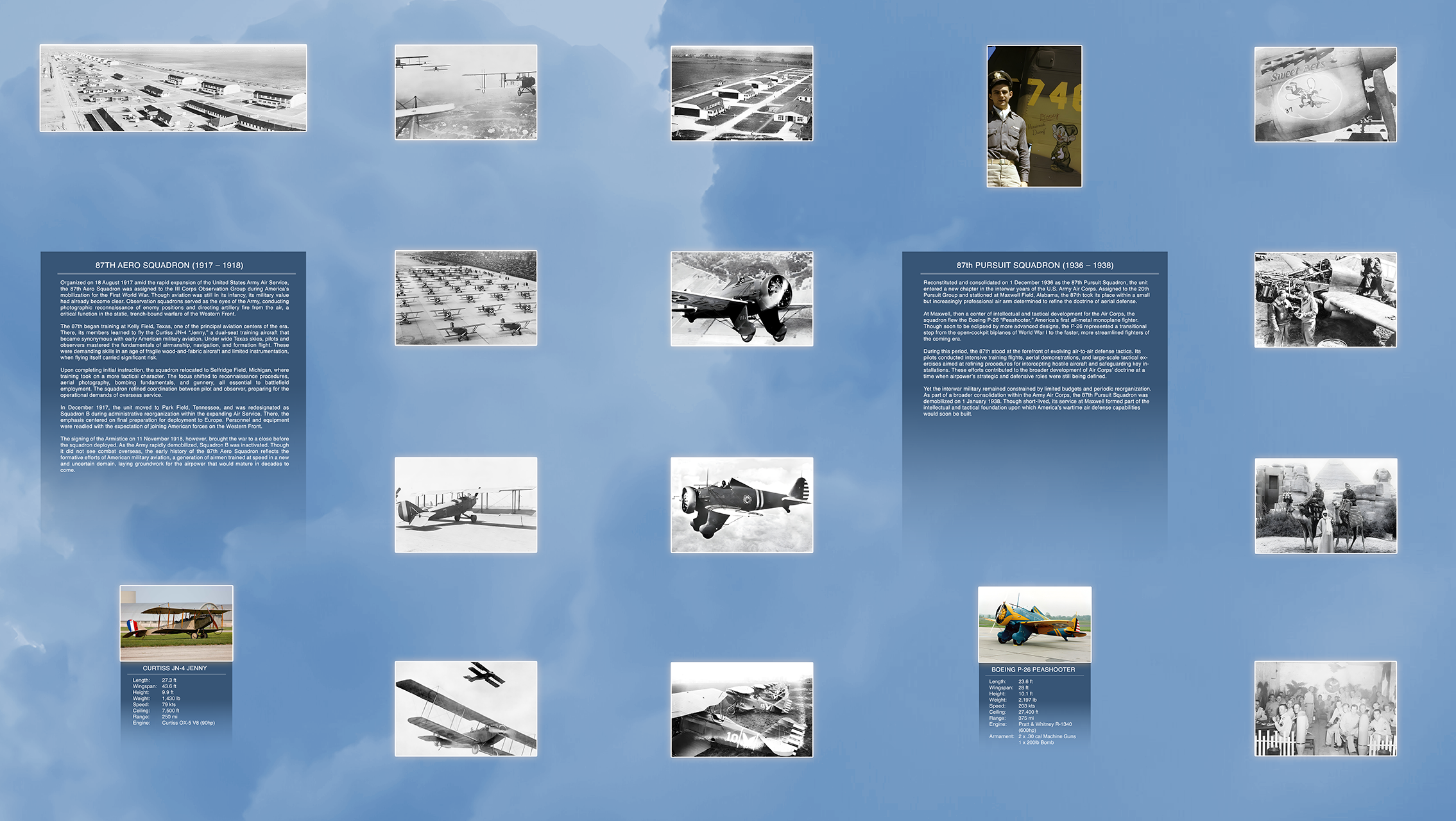
Organized on 18 August 1917 amid the rapid expansion of the United States Army Air Service, the 87th Aero Squadron was assigned to the III Corps Observation Group during America’s mobilization for the First World War. Though aviation was still in its infancy, its military value had already become clear. Observation squadrons served as the eyes of the Army, conducting photographic reconnaissance of enemy positions and directing artillery fire from the air, a critical function in the static, trench-bound warfare of the Western Front.
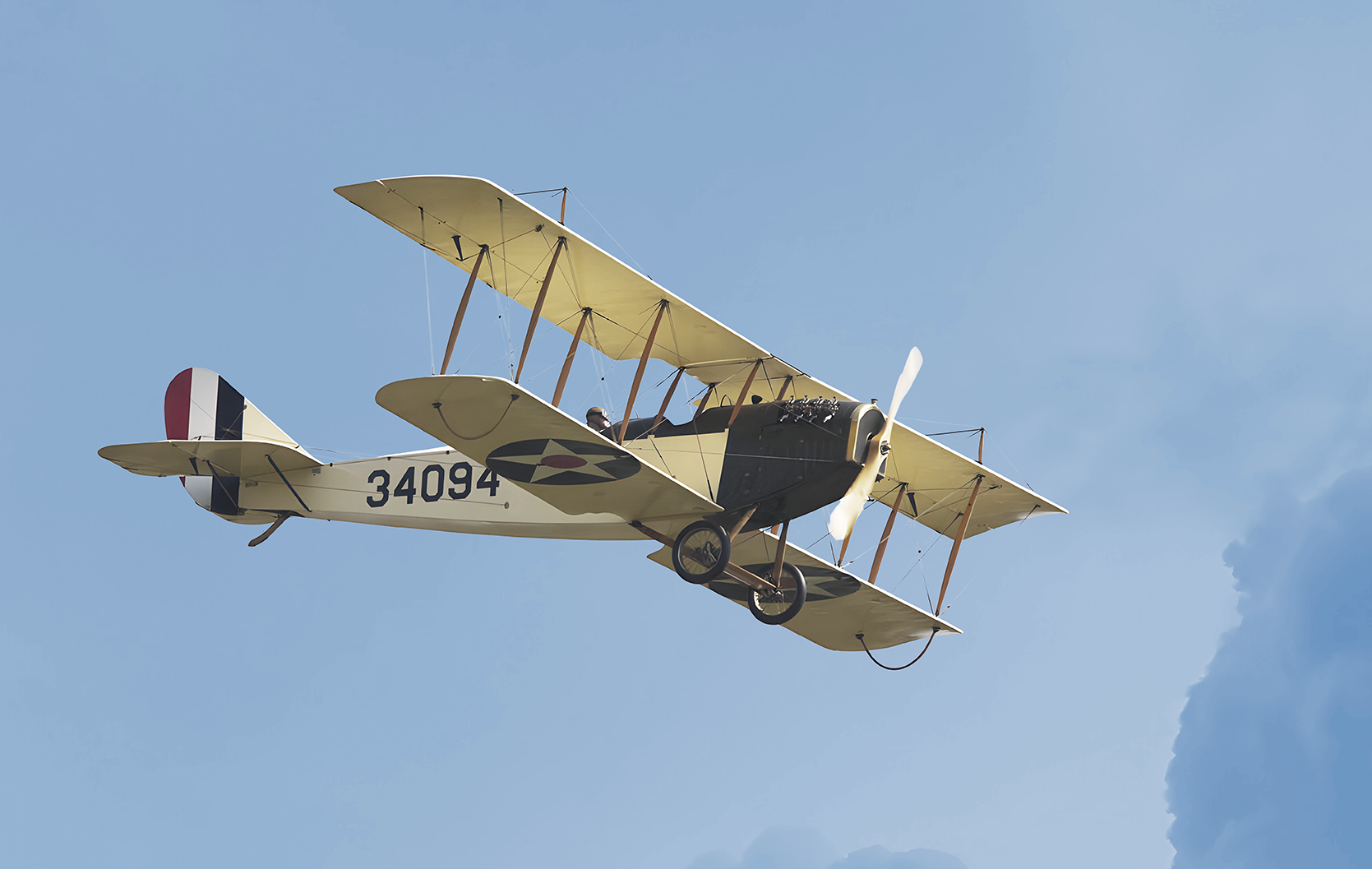
The 87th began training at Kelly Field, Texas, one of the principal aviation centers of the era. There, its members learned to fly the Curtiss JN-4 “Jenny,” a dual-seat training aircraft that became synonymous with early American military aviation. Under wide Texas skies, pilots and observers mastered the fundamentals of airmanship, navigation, and formation flight. These were demanding skills in an age of fragile wood-and-fabric aircraft and limited instrumentation, when flying itself carried significant risk.
Upon completing initial instruction, the squadron relocated to Selfridge Field, Michigan, where training took on a more tactical character. The focus shifted to reconnaissance procedures, aerial photography, bombing fundamentals, and gunnery, all essential to battlefield employment. The squadron refined coordination between pilot and observer, preparing for the operational demands of overseas service.
In December 1917, the unit moved to Park Field, Tennessee, and was redesignated as Squadron B during administrative reorganization within the expanding Air Service. There, the emphasis centered on final preparation for deployment to Europe. Personnel and equipment were readied with the expectation of joining American forces on the Western Front.
The signing of the Armistice on 11 November 1918, however, brought the war to a close before the squadron deployed. As the Army rapidly demobilized, Squadron B was inactivated. Though it did not see combat overseas, the early history of the 87th Aero Squadron reflects the formative efforts of American military aviation, a generation of airmen trained at speed in a new and uncertain domain, laying groundwork for the airpower that would mature in decades to come.
87th PURSUIT SQUADRON (1936 – 1938)
Reconstituted and consolidated on 1 December 1936 as the 87th Pursuit Squadron, the unit entered a new chapter in the interwar years of the U.S. Army Air Corps. Assigned to the 20th Pursuit Group and stationed at Maxwell Field, Alabama, the 87th took its place within a small but increasingly professional air arm determined to refine the doctrine of aerial defense.
At Maxwell, then a center of intellectual and tactical development for the Air Corps, the squadron flew the Boeing P-26 “Peashooter,” America’s first all-metal monoplane fighter. Though soon to be eclipsed by more advanced designs, the P-26 represented a transitional step from the open-cockpit biplanes of World War I to the faster, more streamlined fighters of the coming era.
During this period, the 87th stood at the forefront of evolving air-to-air defense tactics. Its pilots conducted intensive training flights, aerial demonstrations, and large-scale tactical exercises aimed at refining procedures for intercepting hostile aircraft and safeguarding key installations. These efforts contributed to the broader development of Air Corps’ doctrine at a time when airpower’s strategic and defensive roles were still being defined.
Yet the interwar military remained constrained by limited budgets and periodic reorganization. As part of a broader consolidation within the Army Air Corps, the 87th Pursuit Squadron was demobilized on 1 January 1938. Though short-lived, its service at Maxwell formed part of the intellectual and tactical foundation upon which America’s wartime air defense capabilities would soon be built.
87th FIGHTER SQUADRON (1942-1947)
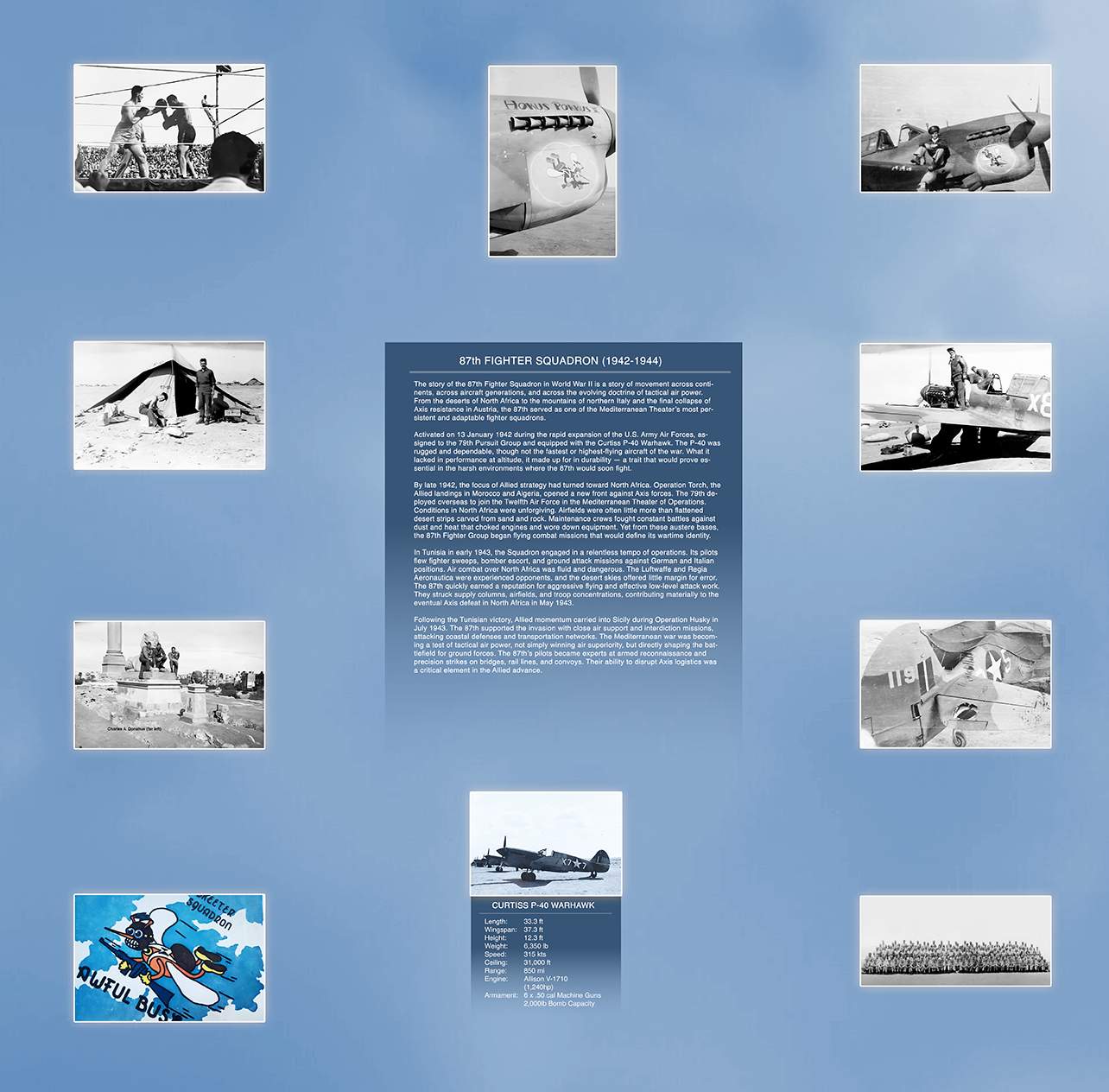
The story of the 87th Fighter Squadron in World War II is a story of movement across continents, across aircraft generations, and across the evolving doctrine of tactical air power. From the deserts of North Africa to the mountains of northern Italy and the final collapse of Axis resistance in Austria, the 87th served as one of the Mediterranean Theater’s most persistent and adaptable fighter squadrons.
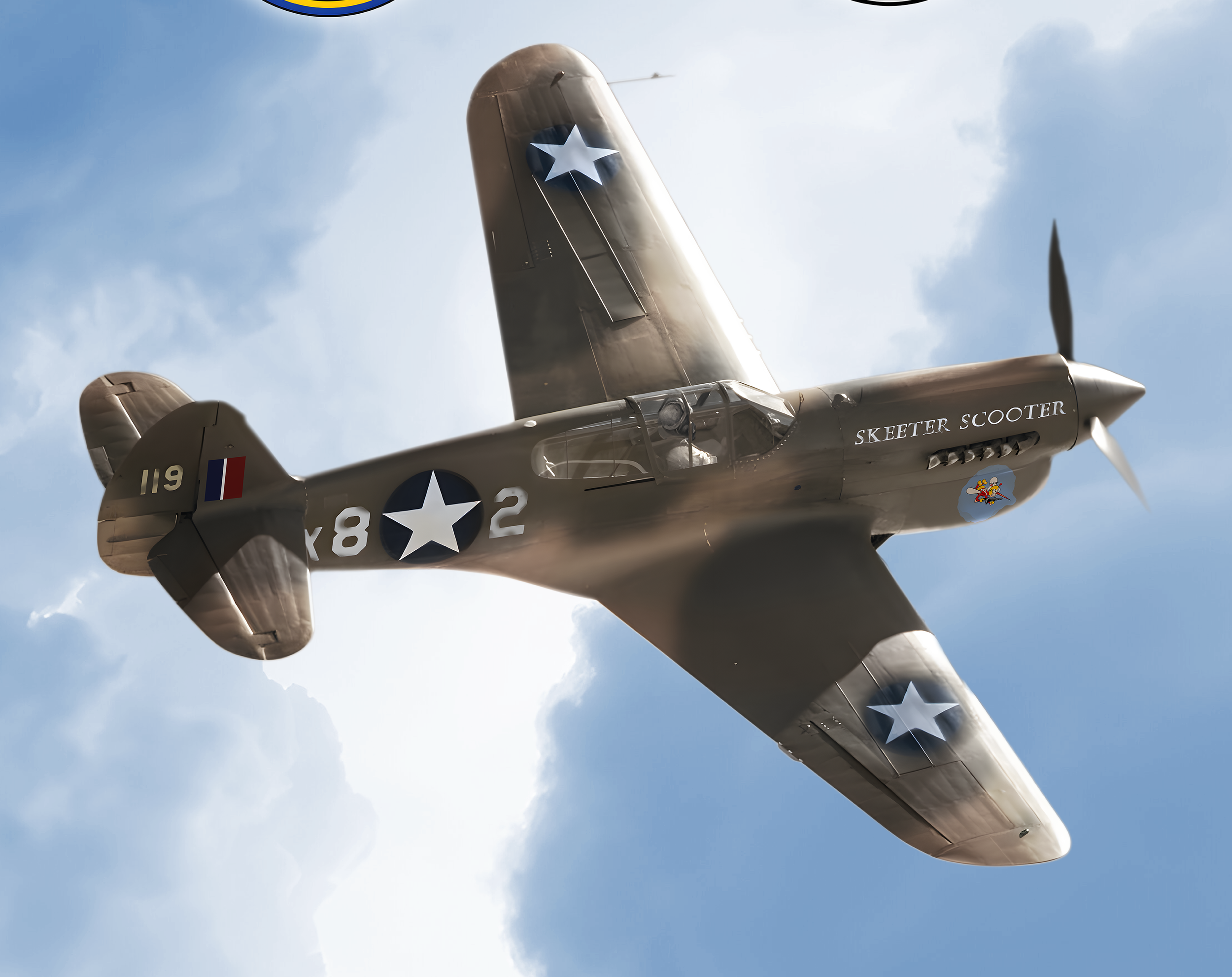
Activated on 13 January 1942 during the rapid expansion of the U.S. Army Air Forces, assigned to the 79th Pursuit Group and equipped with the Curtiss P-40 Warhawk. The P-40 was rugged and dependable, though not the fastest or highest-flying aircraft of the war. What it lacked in performance at altitude, it made up for in durability — a trait that would prove essential in the harsh environments where the 87th would soon fight.
By late 1942, the focus of Allied strategy had turned toward North Africa. Operation Torch, the Allied landings in Morocco and Algeria, opened a new front against Axis forces. The 79th deployed overseas to join the Twelfth Air Force in the Mediterranean Theater of Operations. Conditions in North Africa were unforgiving. Airfields were often little more than flattened desert strips carved from sand and rock. Maintenance crews fought constant battles against dust and heat that choked engines and wore down equipment. Yet from these austere bases, the 87th Fighter Group began flying combat missions that would define its wartime identity.
In Tunisia in early 1943, the Squadron engaged in a relentless tempo of operations. Its pilots flew fighter sweeps, bomber escort, and ground attack missions against German and Italian positions. Air combat over North Africa was fluid and dangerous. The Luftwaffe and Regia Aeronautica were experienced opponents, and the desert skies offered little margin for error. The 87th quickly earned a reputation for aggressive flying and effective low-level attack work. They struck supply columns, airfields, and troop concentrations, contributing materially to the eventual Axis defeat in North Africa in May 1943.
Following the Tunisian victory, Allied momentum carried into Sicily during Operation Husky in July 1943. The 87th supported the invasion with close air support and interdiction missions, attacking coastal defenses and transportation networks. The Mediterranean war was becoming a test of tactical air power, not simply winning air superiority, but directly shaping the battlefield for ground forces. The 87th’s pilots became experts at armed reconnaissance and precision strikes on bridges, rail lines, and convoys. Their ability to disrupt Axis logistics was a critical element in the Allied advance.
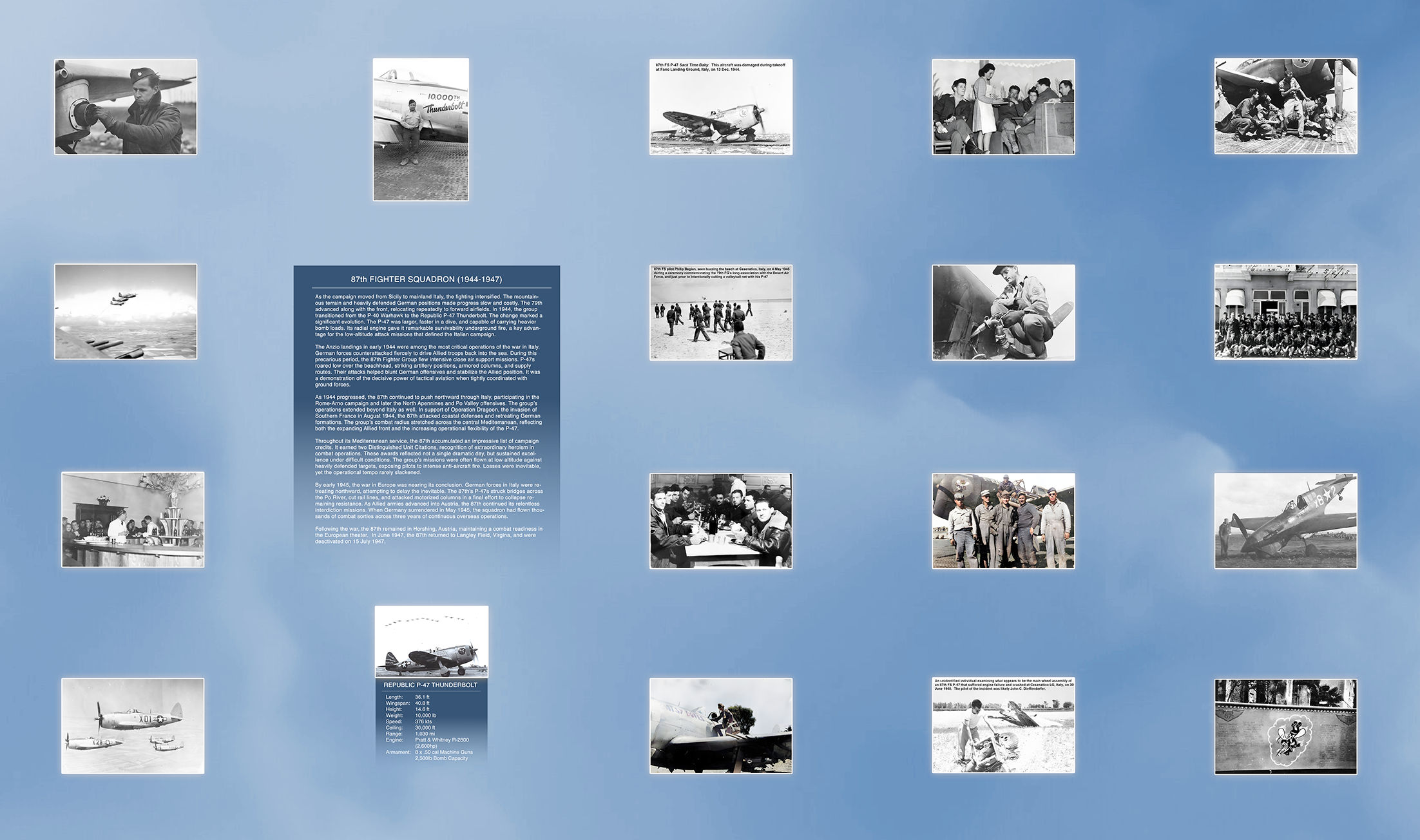
As the campaign moved from Sicily to mainland Italy, the fighting intensified. The mountainous terrain and heavily defended German positions made progress slow and costly. The 79th advanced along with the front, relocating repeatedly to forward airfields. In 1944, the group transitioned from the P-40 Warhawk to the Republic P-47 Thunderbolt. The change marked a significant evolution. The P-47 was larger, faster in a dive, and capable of carrying heavier bomb loads. Its radial engine gave it remarkable survivability underground fire, a key advantage for the low-altitude attack missions that defined the Italian campaign.
The Anzio landings in early 1944 were among the most critical operations of the war in Italy. German forces counterattacked fiercely to drive Allied troops back into the sea. During this precarious period, the 87th Fighter Group flew intensive close air support missions. P-47s roared low over the beachhead, striking artillery positions, armored columns, and supply routes. Their attacks helped blunt German offensives and stabilize the Allied position. It was a demonstration of the decisive power of tactical aviation when tightly coordinated with ground forces.
As 1944 progressed, the 87th continued to push northward through Italy, participating in the Rome-Arno campaign and later the North Apennines and Po Valley offensives. The group’s operations extended beyond Italy as well. In support of Operation Dragoon, the invasion of Southern France in August 1944, the 87th attacked coastal defenses and retreating German formations. The group’s combat radius stretched across the central Mediterranean, reflecting both the expanding Allied front and the increasing operational flexibility of the P-47.
Throughout its Mediterranean service, the 87th accumulated an impressive list of campaign credits. It earned two Distinguished Unit Citations, recognition of extraordinary heroism in combat operations. These awards reflected not a single dramatic day, but sustained excellence under difficult conditions. The group’s missions were often flown at low altitude against heavily defended targets, exposing pilots to intense anti-aircraft fire. Losses were inevitable, yet the operational tempo rarely slackened.
By early 1945, the war in Europe was nearing its conclusion. German forces in Italy were retreating northward, attempting to delay the inevitable. The 87th’s P-47s struck bridges across the Po River, cut rail lines, and attacked motorized columns in a final effort to collapse remaining resistance. As Allied armies advanced into Austria, the 87th continued its relentless interdiction missions. When Germany surrendered in May 1945, the squadron had flown thousands of combat sorties across three years of continuous overseas operations.
Following the war, the 87th remained in Horshing, Austria, maintaining a combat readiness in the European theater. In June 1947, the 87th returned to Langley Field, Virgina, and were deactivated on 15 July 1947.
87th FIGHTER INTERCEPTOR SQUADRON (1952-1955)
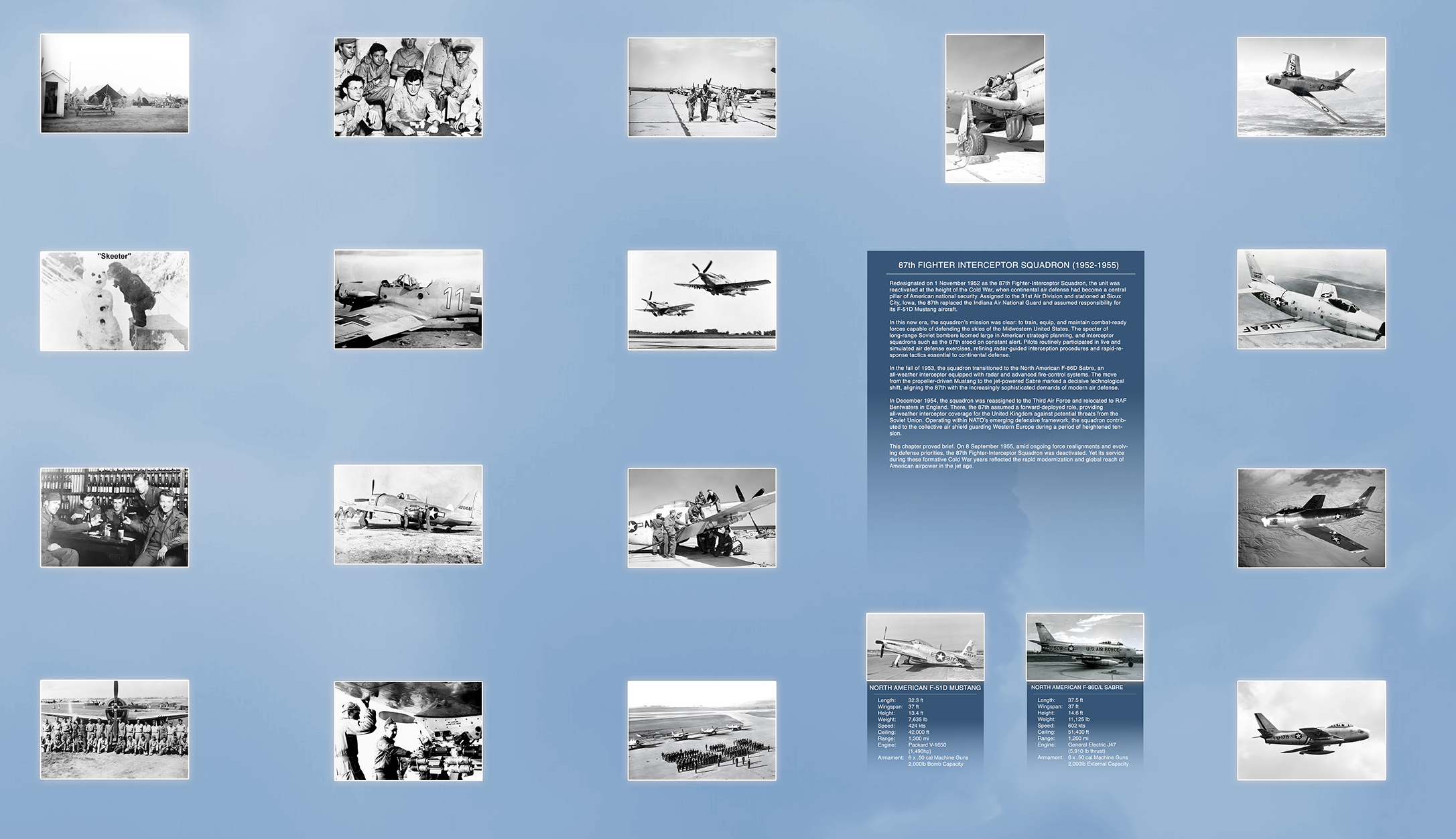
Redesignated on 1 November 1952 as the 87th Fighter-Interceptor Squadron, the unit was reactivated at the height of the Cold War, when continental air defense had become a central pillar of American national security. Assigned to the 31st Air Division and stationed at Sioux City, Iowa, the 87th replaced the Indiana Air National Guard and assumed responsibility for its F-51D Mustang aircraft.
In this new era, the squadron’s mission was clear: to train, equip, and maintain combat-ready forces capable of defending the skies of the Midwestern United States. The specter of long-range Soviet bombers loomed large in American strategic planning, and interceptor squadrons such as the 87th stood on constant alert. Pilots routinely participated in live and simulated air defense exercises, refining radar-guided interception procedures and rapid-response tactics essential to continental defense.
In the fall of 1953, the squadron transitioned to the North American F-86D Sabre, an all-weather interceptor equipped with radar and advanced fire-control systems. The move from the propeller-driven Mustang to the jet-powered Sabre marked a decisive technological shift, aligning the 87th with the increasingly sophisticated demands of modern air defense.
In December 1954, the squadron was reassigned to the Third Air Force and relocated to RAF Bentwaters in England. There, the 87th assumed a forward-deployed role, providing all-weather interceptor coverage for the United Kingdom against potential threats from the Soviet Union. Operating within NATO’s emerging defensive framework, the squadron contributed to the collective air shield guarding Western Europe during a period of heightened tension.
This chapter proved brief. On 8 September 1955, amid ongoing force realignments and evolving defense priorities, the 87th Fighter-Interceptor Squadron was deactivated. Yet its service during these formative Cold War years reflected the rapid modernization and global reach of American airpower in the jet age.
87TH FIGHTER INTERCEPTOR SQUADRON (1956-1968)
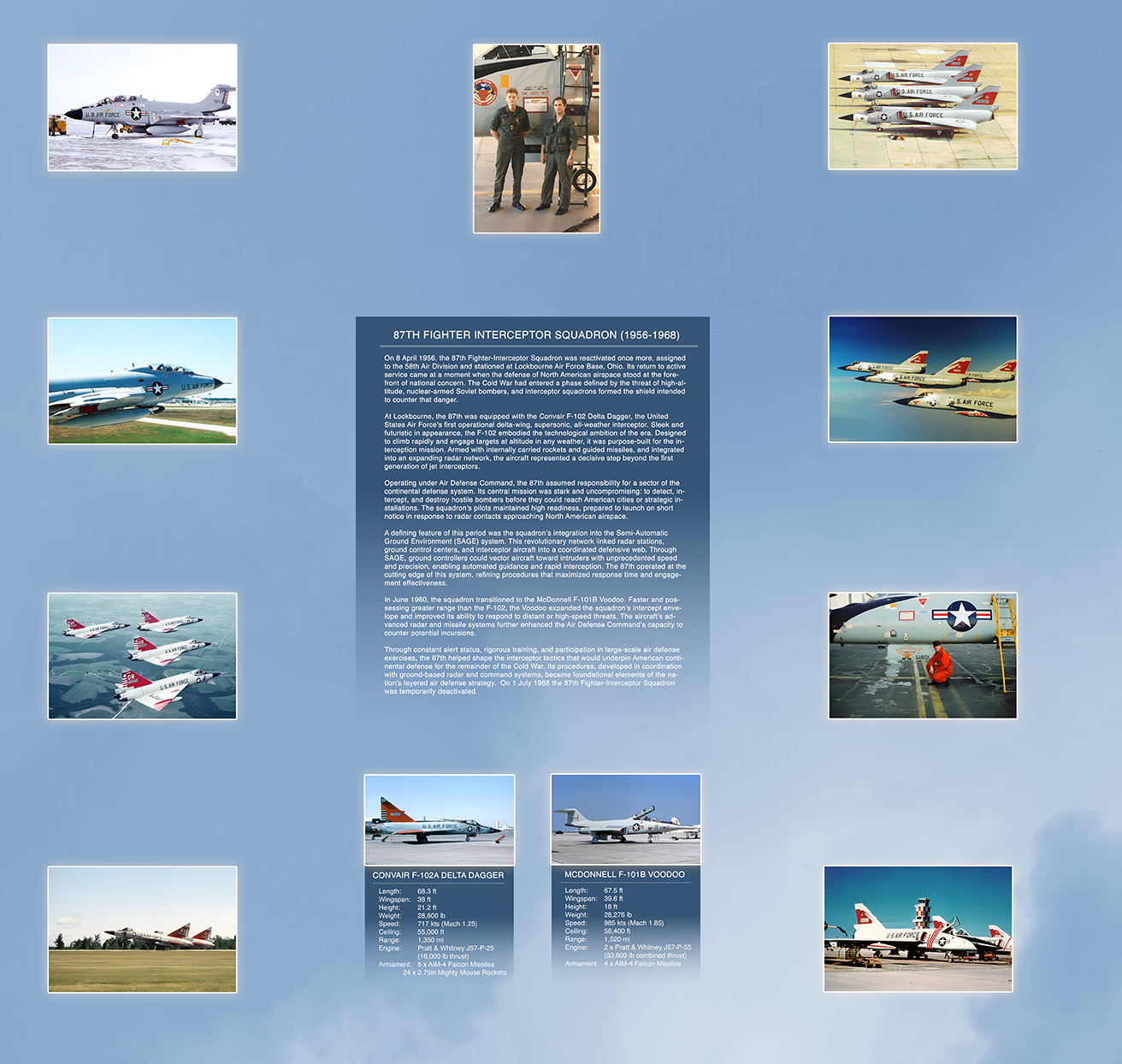
On 8 April 1956, the 87th Fighter-Interceptor Squadron was reactivated once more, assigned to the 58th Air Division and stationed at Lockbourne Air Force Base, Ohio. Its return to active service came at a moment when the defense of North American airspace stood at the forefront of national concern. The Cold War had entered a phase defined by the threat of high-altitude, nuclear-armed Soviet bombers, and interceptor squadrons formed the shield intended to counter that danger.
At Lockbourne, the 87th was equipped with the Convair F-102 Delta Dagger, the United States Air Force’s first operational delta-wing, supersonic, all-weather interceptor. Sleek and futuristic in appearance, the F-102 embodied the technological ambition of the era. Designed to climb rapidly and engage targets at altitude in any weather, it was purpose-built for the interception mission. Armed with internally carried rockets and guided missiles, and integrated into an expanding radar network, the aircraft represented a decisive step beyond the first generation of jet interceptors.
Operating under Air Defense Command, the 87th assumed responsibility for a sector of the continental defense system. Its central mission was stark and uncompromising: to detect, intercept, and destroy hostile bombers before they could reach American cities or strategic installations. The squadron’s pilots maintained high readiness, prepared to launch on short notice in response to radar contacts approaching North American airspace.
A defining feature of this period was the squadron’s integration into the Semi-Automatic Ground Environment (SAGE) system. This revolutionary network linked radar stations, ground control centers, and interceptor aircraft into a coordinated defensive web. Through SAGE, ground controllers could vector aircraft toward intruders with unprecedented speed and precision, enabling automated guidance and rapid interception. The 87th operated at the cutting edge of this system, refining procedures that maximized response time and engagement effectiveness.
In June 1960, the squadron transitioned to the McDonnell F-101B Voodoo. Faster and possessing greater range than the F-102, the Voodoo expanded the squadron’s intercept envelope and improved its ability to respond to distant or high-speed threats. The aircraft’s advanced radar and missile systems further enhanced the Air Defense Command’s capacity to counter potential incursions.
Through constant alert status, rigorous training, and participation in large-scale air defense exercises, the 87th helped shape the interceptor tactics that would underpin American continental defense for the remainder of the Cold War. Its procedures, developed in coordination with ground-based radar and command systems, became foundational elements of the nation’s layered air defense strategy. On 1 July 1968 the 87th Fighter-Interceptor Squadron was temporarily deactivated.
87th FIGHTER INTERCEPTOR SQUADRON (1968-1985)
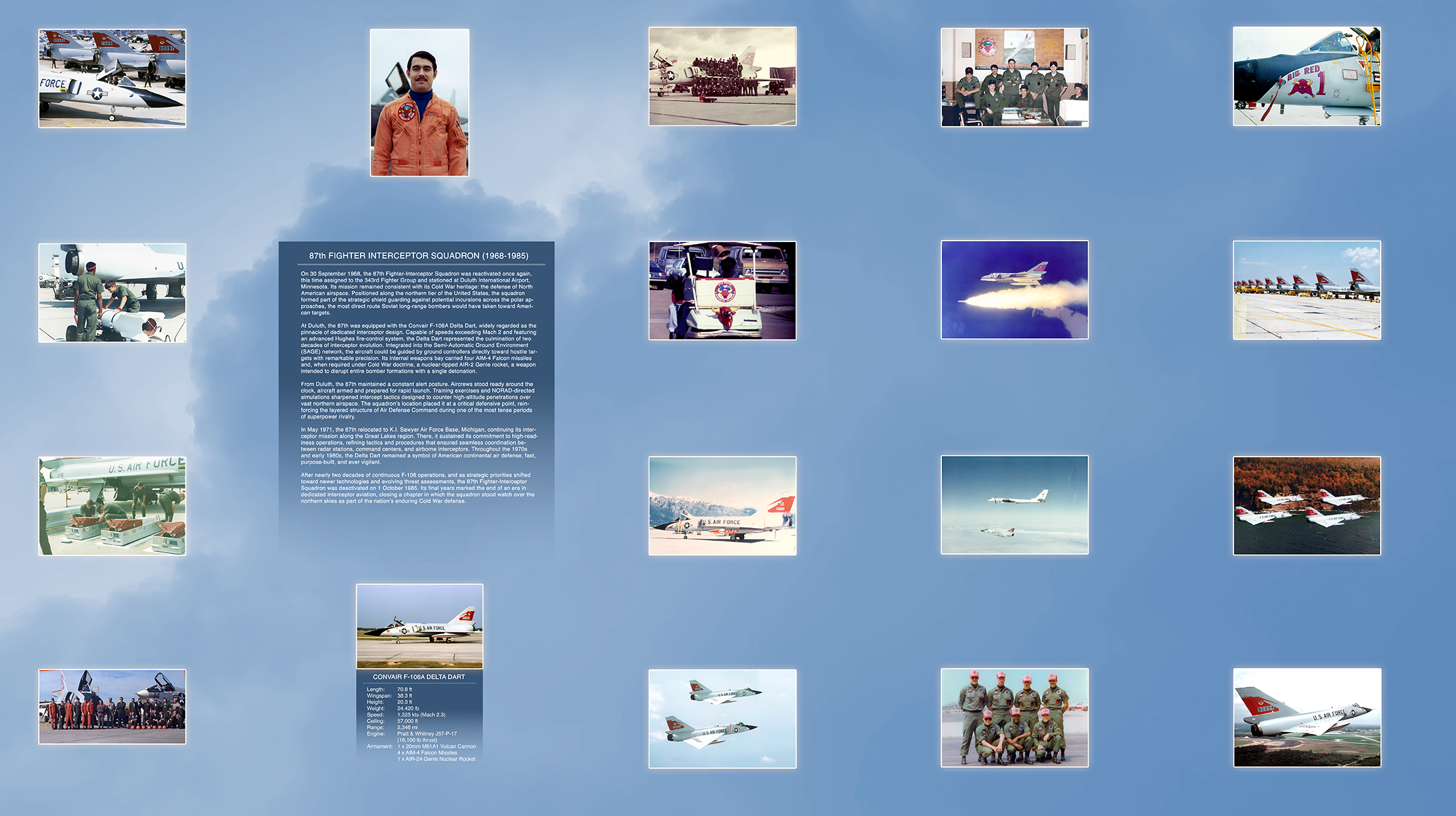
On 30 September 1968, the 87th Fighter-Interceptor Squadron was reactivated once again, this time assigned to the 343rd Fighter Group and stationed at Duluth International Airport, Minnesota. Its mission remained consistent with its Cold War heritage: the defense of North American airspace. Positioned along the northern tier of the United States, the squadron formed part of the strategic shield guarding against potential incursions across the polar approaches, the most direct route Soviet long-range bombers would have taken toward American targets.
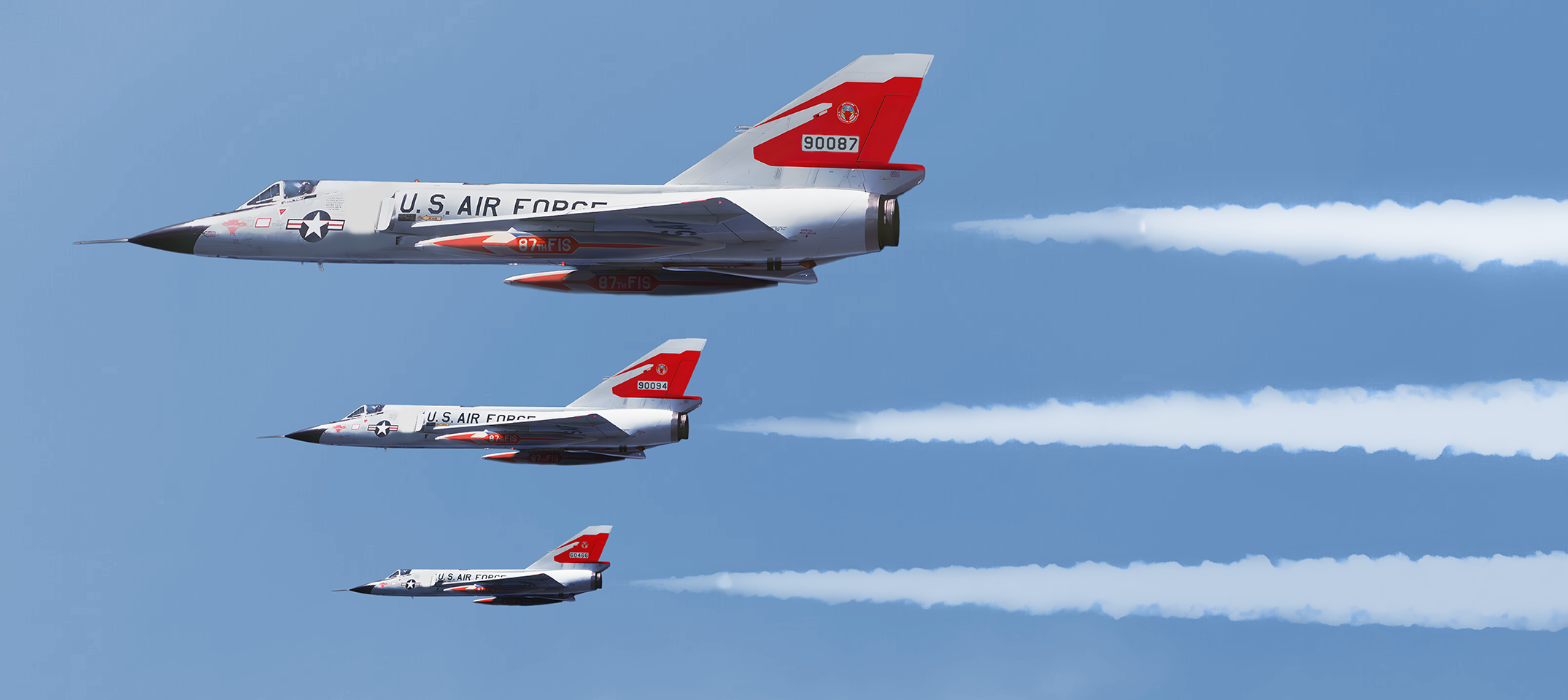
At Duluth, the 87th was equipped with the Convair F-106A Delta Dart, widely regarded as the pinnacle of dedicated interceptor design. Capable of speeds exceeding Mach 2 and featuring an advanced Hughes fire-control system, the Delta Dart represented the culmination of two decades of interceptor evolution. Integrated into the Semi-Automatic Ground Environment (SAGE) network, the aircraft could be guided by ground controllers directly toward hostile targets with remarkable precision. Its internal weapons bay carried four AIM-4 Falcon missiles and, when required under Cold War doctrine, a nuclear-tipped AIR-2 Genie rocket, a weapon intended to disrupt entire bomber formations with a single detonation.
From Duluth, the 87th maintained a constant alert posture. Aircrews stood ready around the clock, aircraft armed and prepared for rapid launch. Training exercises and NORAD-directed simulations sharpened intercept tactics designed to counter high-altitude penetrations over vast northern airspace. The squadron’s location placed it at a critical defensive point, reinforcing the layered structure of Air Defense Command during one of the most tense periods of superpower rivalry.
In May 1971, the 87th relocated to K.I. Sawyer Air Force Base, Michigan, continuing its interceptor mission along the Great Lakes region. There, it sustained its commitment to high-readiness operations, refining tactics and procedures that ensured seamless coordination between radar stations, command centers, and airborne interceptors. Throughout the 1970s and early 1980s, the Delta Dart remained a symbol of American continental air defense, fast, purpose-built, and ever vigilant.
After nearly two decades of continuous F-106 operations, and as strategic priorities shifted toward newer technologies and evolving threat assessments, the 87th Fighter-Interceptor Squadron was deactivated on 1 October 1985. Its final years marked the end of an era in dedicated interceptor aviation, closing a chapter in which the squadron stood watch over the northern skies as part of the nation’s enduring Cold War defense.